
Scouting Roles & Archetypes: Identifying Floor Generals in Australia's NBL
Shot Clock | Scouting & Analytics Department
Beyond Traditional Positions: Understanding the Floor General
Modern basketball scouting is increasingly moving away from traditional positional classifications toward a more detailed understanding of player roles, tactical responsibilities, and offensive characteristics.
Two players may both be listed as point guards, operate within similar offensive systems, and produce comparable statistical averages, yet contribute to their teams in fundamentally different ways.
One may generate advantages through individual scoring pressure, another through pick-and-roll decision-making, while a third may prioritize ball circulation, offensive organization, and maintaining the flow of possessions.
At Shot Clock, our scouting framework distinguishes between four primary point guard archetypes:
- Floor General: An offensive organizer focused on decision-making, playmaking efficiency, and creating advantages for teammates.
- Scoring Point: A high-volume offensive creator who generates scoring opportunities primarily through individual shot creation and scoring gravity.
- Two-Way Point Guard: A guard combining offensive responsibilities with significant defensive contributions.
- Ball Mover: A guard who facilitates offensive continuity through quick decisions, ball circulation, and efficient connective playmaking.
In this analysis, we focus specifically on the Floor General archetype, examining how advanced creation metrics and percentile-based comparisons can help identify different offensive profiles in Australia's National Basketball League (NBL).
Our objective is not simply to rank point guards. It is to understand how players create offensive advantages, how efficiently they manage their responsibilities, and which profiles may be best suited to particular tactical environments.
1. What Defines a Floor General?
The Floor General is the offensive conductor of a basketball team.
His primary responsibility is not necessarily to lead the team in scoring, but to maximize the efficiency of offensive possessions by organizing teammates, reading defensive coverages, controlling tempo, and consistently making effective decisions.
Rather than forcing offense through individual shot creation, the Floor General prioritizes creating advantages for others and ensuring that the team's offensive structure functions effectively.
Offensive responsibilities
An effective Floor General is expected to:
- Initiate offensive actions and control tempo.
- Create advantages through pick-and-roll decision-making.
- Manipulate weak-side defenders and defensive rotations.
- Recognize favorable matchups and exploit defensive mistakes.
- Organize spacing and maintain offensive structure.
- Balance scoring aggression with playmaking responsibilities.
- Minimize unnecessary turnovers and inefficient decisions.
An important distinction is that being a Floor General does not mean being a low-volume scorer.
A player can generate significant individual scoring pressure while simultaneously functioning as an elite offensive organizer.
In fact, scoring gravity can become an essential mechanism for creating advantages for teammates. When defenders are forced to react aggressively to a ball handler's scoring threat, additional passing opportunities and offensive advantages emerge.
Therefore, the central question is not how frequently a point guard scores, but how effectively his offensive involvement translates into advantages for the team.
Defensive responsibilities
Although the Floor General classification is primarily offensive, point guards must also be evaluated within their defensive responsibilities.
These include defending opposing ball handlers, navigating screens, applying pressure at the point of attack, communicating defensive coverages, and preventing easy offensive initiation.
Defensive evaluation should remain a separate dimension rather than being automatically inferred from a player's offensive archetype.
2. Measuring Offensive Creation: Creation Load & Creation Quality
To better understand the different ways point guards influence offensive possessions, we examine two complementary dimensions: Creation Load and Creation Quality.
Creation Load: How much offensive responsibility does a player carry?
Creation Load represents the extent to which a player is responsible for generating offensive opportunities.
Players with higher Creation Load typically carry greater on-ball responsibilities, initiate more offensive actions, and are involved more frequently in situations requiring offensive decision-making.
A high Creation Load does not automatically indicate superior playmaking ability.
It may reflect a team's offensive structure, the absence of alternative creators, or a tactical system built around a dominant ball handler.
Consequently, creation volume must always be interpreted alongside the quality of the opportunities being generated.
Creation Quality: How effectively does a player create?
Creation Quality focuses on the effectiveness of a player's offensive creation.
Rather than rewarding involvement alone, this dimension aims to capture how successfully a player converts offensive responsibility into productive opportunities.
For the Floor General archetype, this distinction is particularly important.
A player who initiates fewer possessions but consistently creates favorable opportunities may demonstrate stronger facilitation characteristics than a player who dominates the ball without generating equivalent offensive value.
Creation Load measures the extent of responsibility. Creation Quality measures the effectiveness of creation.
Together, these dimensions offer a more informative perspective than traditional assists-per-game rankings.
Methodological note: Both metrics are treated here as proprietary Shot Clock indicators. Their precise mathematical definitions and weighting are not disclosed in this analysis. The scatter plot supports relative comparisons within the selected sample, not causal conclusions about team offensive efficiency.
3. Mapping NBL Point Guards: Creation Load vs. Creation Quality
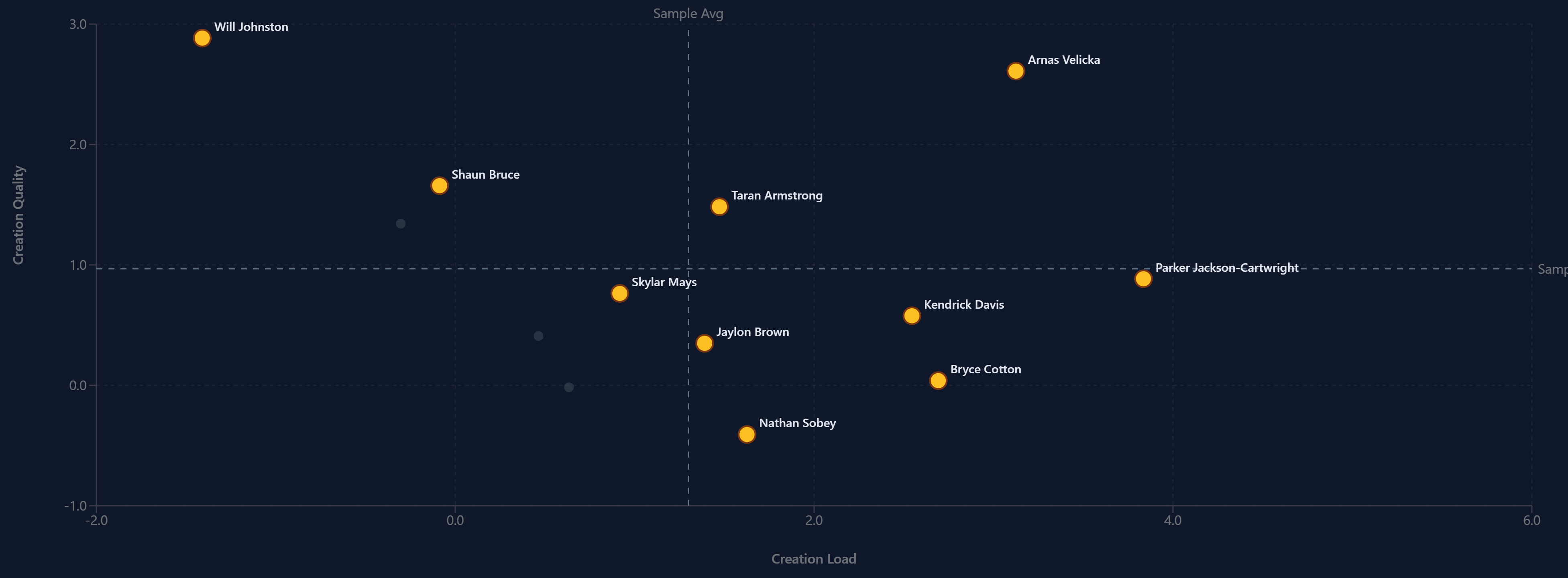
Our scatter plot positions selected NBL guards according to their Creation Load and Creation Quality.
The horizontal axis represents Creation Load, while the vertical axis represents Creation Quality.
The reference lines indicate the averages of the comparison sample, dividing the visualization into four analytical regions.
High Creation Load / High Creation Quality
Players in this region combine significant offensive responsibility with above-average creation effectiveness.
This is particularly interesting when scouting primary offensive organizers because these players demonstrate the ability to maintain productive creation while handling substantial offensive involvement.
Low Creation Load / High Creation Quality
These players demonstrate above-average creation effectiveness without carrying equally high creation responsibility.
They may represent efficient secondary creators or guards whose playmaking responsibilities could potentially expand within a different offensive environment.
However, projecting their effectiveness into a larger role requires additional evaluation.
High Creation Load / Low Creation Quality
Players in this region carry significant offensive responsibility but demonstrate below-average Creation Quality within the selected sample.
This does not necessarily indicate poor offensive players.
Some may operate as scoring-oriented guards whose primary responsibility is to generate individual offense rather than maximize facilitation.
Others may be working within demanding offensive environments where difficult shot creation and limited supporting personnel influence their statistical profile.
Low Creation Load / Low Creation Quality
These players operate with relatively limited creation responsibility and below-average Creation Quality.
They may be better suited to complementary offensive responsibilities, although their overall value must also be assessed through shooting, defense, off-ball movement, and other dimensions.
Importantly, these quadrants are descriptive classifications, not definitive player rankings.
4. Player Analysis: Who Stands Out?
The selected NBL sample presents several interesting offensive profiles.
Arnas Velicka: High-Volume Creation With Strong Facilitation
Arnas Velicka emerges as one of the most interesting Floor General candidates in the comparison.
He combines a Creation Load of approximately 3.1 with a Creation Quality of approximately 2.6, placing him comfortably above the sample averages in both dimensions.
This combination suggests a player capable of handling substantial offensive responsibility while maintaining strong creation effectiveness.
The percentile analysis further supports his playmaking profile.
Key indicators:
- PnR Ball-Handler: 94th percentile
- Assist/Turnover: 4.18 — 94th percentile
- True Shooting: 42.5% — 11th percentile
Velicka's Assist/Turnover ratio is particularly notable.
An excellent ratio, combined with significant pick-and-roll involvement, indicates an ability to facilitate offense without producing an excessive number of turnovers relative to assists.
However, his shooting efficiency introduces an important limitation.
A 42.5% True Shooting percentage places him in the 11th percentile of the comparison sample, suggesting that individual scoring efficiency is currently a weakness.
This creates an interesting scouting profile: a guard whose primary value appears to come from offensive organization and facilitation rather than efficient individual scoring.
For teams searching for a traditional offensive organizer, Velicka deserves further examination.
The next scouting question would be whether his limited shooting efficiency allows opposing defenses to reduce pressure on the ball and compromise his ability to create advantages against stronger defensive competition.
His decision-making profile is promising, but evaluating his scoring gravity is essential before projecting his role into a different league.
Bryce Cotton: Offensive Responsibility and Scoring Efficiency
Bryce Cotton presents a different offensive profile.
His Creation Load is approximately 2.7, above the sample average, while his Creation Quality is close to zero on the displayed scale.
In the percentile comparison, Cotton records:
- PnR Ball-Handler: 84th percentile
- True Shooting: 61.3% — 66th percentile
- Assist/Turnover: 2.00 — 71st percentile
The contrast with Velicka is revealing.
Cotton demonstrates substantially stronger individual scoring efficiency, while Velicka records a much higher Assist/Turnover ratio and Creation Quality.
This illustrates why traditional positional classifications can be misleading.
Both players handle offensive responsibilities, but their statistical profiles suggest different mechanisms of offensive impact.
Cotton's profile is more closely associated with individual offensive production and scoring effectiveness, while Velicka's indicators suggest stronger facilitation characteristics.
Cotton's lower Creation Quality should not be interpreted as lower overall offensive value.
A scoring-oriented guard can generate significant value through shot-making, defensive attention, and the ability to create offense in difficult situations, even when his facilitation indicators are less impressive.
This is precisely why player evaluation requires role-specific metrics rather than a single universal ranking.
Kendrick Davis: Significant On-Ball Involvement
Kendrick Davis is another interesting case.
His Creation Load is approximately 2.5, while his Creation Quality sits around 0.6, below the sample average.
His percentile profile includes:
- PnR Ball-Handler: 99th percentile
- Assist/Turnover: 2.75 — 89th percentile
- True Shooting: 48.4% — 24th percentile
The 99th-percentile PnR Ball-Handler ranking highlights his strong pick-and-roll involvement and production relative to the comparison sample.
Meanwhile, his 89th-percentile Assist/Turnover ratio indicates favorable assist production relative to turnovers.
However, his True Shooting percentage suggests limitations in individual scoring efficiency.
Davis therefore presents a profile combining significant on-ball responsibility with respectable playmaking indicators, without reaching the same Creation Quality level as Velicka.
His evaluation should focus on the relationship between the advantages he generates and the offensive decisions that follow.
Does he consistently create favorable situations for teammates? How much of his offensive involvement results in high-quality scoring opportunities? And how effectively can he operate when the ball is not primarily in his hands?
These are important questions when determining whether a player is best suited to a Floor General role or a different offensive archetype.
Parker Jackson-Cartwright: High Creation Responsibility, Different Efficiency Profile
Parker Jackson-Cartwright records the highest Creation Load among the highlighted players in the scatter plot, at approximately 3.8.
His Creation Quality is approximately 0.9, slightly below the sample average.
This positioning is particularly interesting.
Jackson-Cartwright carries considerable offensive responsibility, yet his Creation Quality does not increase proportionally with his creation volume.
That observation should not be interpreted as an indication of poor decision-making.
High-usage offensive creators often face greater defensive attention, more demanding possessions, and additional responsibility late in the shot clock.
The important scouting question is whether the player's offensive creation is sustainable and efficient within the context of his team's tactical environment.
Jackson-Cartwright's profile warrants additional analysis of his pick-and-roll decisions, passing opportunities, turnover tendencies, and the quality of shots generated for teammates.
Will Johnston: High Creation Quality With Limited Load
Will Johnston occupies one of the most distinctive positions in the visualization.
His Creation Quality is approximately 2.9, the highest among the highlighted players, while his Creation Load is approximately -1.4, considerably below the sample average.
This combination suggests strong creation effectiveness within a relatively limited offensive role.
From a scouting perspective, this profile is particularly interesting when identifying potentially undervalued facilitators.
However, the central challenge is determining whether that effectiveness can be maintained with increased responsibility.
A player operating in a limited creation role may benefit from favorable matchups, selective opportunities, or an offensive system that reduces the difficulty of his decisions.
Before projecting Johnston into a larger offensive role, it would be necessary to evaluate the types of possessions he initiates, the defensive pressure he faces, and his effectiveness when required to create advantages independently.
High Creation Quality at low Creation Load is a promising scouting signal, not proof that a player can become a primary creator.
Shaun Bruce and Taran Armstrong: Alternative Facilitation Profiles
Shaun Bruce and Taran Armstrong both appear above the sample average in Creation Quality, but with different levels of offensive responsibility.
Bruce records approximately -0.1 Creation Load and 1.6 Creation Quality, suggesting above-average creation effectiveness despite relatively modest creation responsibility.
Armstrong records approximately 1.5 Creation Load and 1.5 Creation Quality, combining above-average creation responsibility with similarly strong effectiveness.
The difference matters when considering potential roster roles.
Bruce's positioning may be particularly relevant for teams searching for a complementary organizer who can maintain offensive continuity.
Armstrong's profile suggests a player handling greater creation responsibility while maintaining favorable effectiveness.
Neither interpretation should be treated as a definitive role assignment without reviewing the underlying possessions, but both players warrant further investigation within a Floor General scouting framework.
5. Comparative Overview
The following table summarizes the approximate Creation Load and Creation Quality values visible in the selected NBL scatter plot.
| Player | Creation Load | Creation Quality |
|---|---|---|
| Will Johnston | -1.4 | 2.9 |
| Arnas Velicka | 3.1 | 2.6 |
| Shaun Bruce | -0.1 | 1.6 |
| Taran Armstrong | 1.5 | 1.5 |
| Parker Jackson-Cartwright | 3.8 | 0.9 |
| Skylar Mays | 0.9 | 0.8 |
| Kendrick Davis | 2.5 | 0.6 |
| Jaylon Brown | 1.4 | 0.4 |
| Bryce Cotton | 2.7 | 0.0 |
| Nathan Sobey | 1.6 | -0.4 |
Values are approximations based on the displayed scatter plot, not the underlying dataset. The axes represent the model's relative creation indicators rather than raw counts of possessions or assists.
Several observations emerge.
First, high offensive responsibility does not guarantee high creation effectiveness. Players with similar Creation Load values can occupy significantly different positions on the Creation Quality axis.
Second, efficient creation is not exclusive to high-usage players. Johnston and Bruce demonstrate that strong creation indicators can emerge within more limited offensive responsibilities.
Third, scoring efficiency and creation effectiveness should not be treated as interchangeable concepts. The comparison between Cotton and Velicka illustrates how different offensive profiles can contribute through different mechanisms.
Finally, a player's position on the scatter plot must be interpreted within the context of his tactical responsibilities, supporting personnel, and offensive environment.
6. Adding Percentile Analysis to the Scouting Process
Creation Load and Creation Quality provide a useful overview, but they are not sufficient to evaluate a player comprehensively.
To add context, we examine additional performance indicators through percentile comparisons.
Three metrics are particularly relevant to this analysis.
Pick-and-Roll Ball-Handler Production
Pick-and-roll situations are central to modern point guard responsibilities.
The ability to generate offense as a pick-and-roll ball handler provides valuable information about a player's on-ball involvement and effectiveness.
However, the percentile ranking alone does not explain how the player creates his value.
A high ranking may be driven by individual scoring, playmaking, favorable screening actions, or a combination of these factors.
Therefore, detailed play-type evaluation remains essential.
Assist/Turnover Ratio
The Assist/Turnover ratio provides a basic indication of a player's ability to generate assists while limiting turnovers.
For the Floor General archetype, this is particularly relevant because decision-making and offensive organization are central responsibilities.
However, the metric has limitations.
Not every valuable pass results in an assist, and not every turnover represents a poor decision. Players handling more demanding creation responsibilities may also face greater turnover exposure.
Consequently, Assist/Turnover should be interpreted alongside Creation Load, Creation Quality, and video evaluation.
True Shooting Percentage
True Shooting percentage captures scoring efficiency while accounting for two-point attempts, three-point attempts, and free throws.
Its inclusion is important because modern Floor Generals must still present a credible scoring threat.
A guard who struggles to score efficiently may allow opposing defenses to prioritize passing lanes, reduce help commitments, or defend pick-and-roll actions more conservatively.
This can influence the player's ability to create advantages for teammates.
The comparison between Velicka, Cotton, and Davis demonstrates how significantly shooting efficiency can vary among guards with substantial offensive responsibilities.
Selected percentile comparison
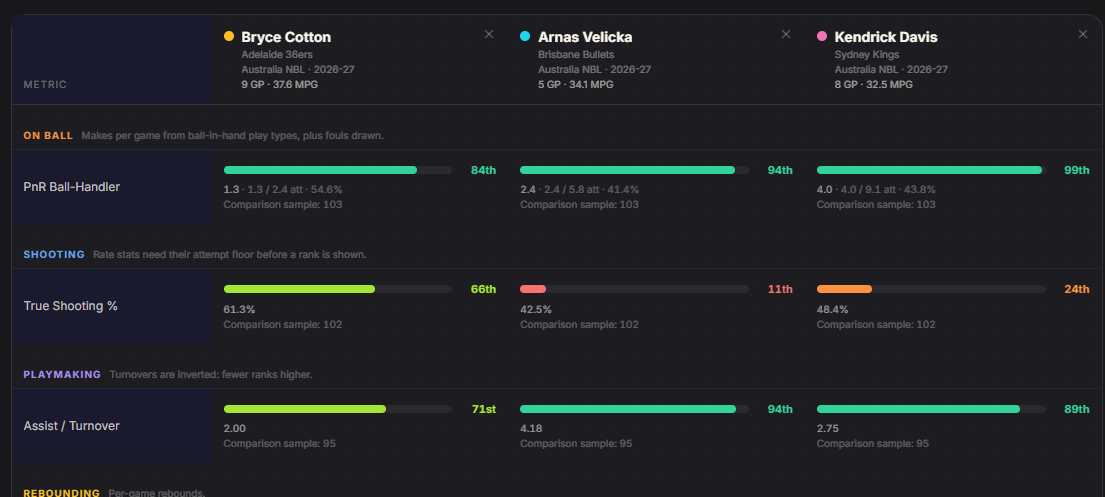
| Metric | Bryce Cotton | Arnas Velicka | Kendrick Davis |
|---|---|---|---|
| PnR Ball-Handler | 84th | 94th | 99th |
| True Shooting % | 66th | 11th | 24th |
| Assist/Turnover | 71st | 94th | 89th |
Percentiles are based on the comparison samples displayed in the Shot Clock scouting dashboard. They represent relative rankings rather than direct measures of overall player quality.
These differences reinforce the importance of multidimensional scouting.
Velicka appears particularly strong in facilitation indicators, Cotton offers the strongest scoring efficiency of the three, and Davis combines significant pick-and-roll production with a favorable Assist/Turnover ranking.
Each profile may be valuable, depending on the tactical responsibilities a team needs to fill.
7. Translating Analytics Into Roster Construction
The ultimate purpose of a scouting framework is not to produce attractive visualizations or statistical rankings.
It is to support better basketball decisions.
Consider three different roster-building scenarios.
Scenario A: A team needs a primary offensive organizer
A roster with strong finishers, effective off-ball shooters, and limited playmaking may benefit from a guard capable of organizing possessions and consistently creating opportunities for teammates.
In this environment, Creation Quality, passing efficiency, defensive manipulation, and offensive decision-making become especially important.
A profile such as Velicka's would warrant further scouting, particularly if the team's existing personnel can compensate for his scoring limitations.
Scenario B: A team lacks individual shot creation
A team struggling to generate offense against set defenses may require a guard capable of producing points independently.
In this case, scoring gravity, shooting efficiency, and the ability to create shots under pressure may be more important than maximizing traditional facilitation indicators.
A player such as Cotton may provide a different type of offensive solution.
Scenario C: A team needs a secondary creator
Some teams already possess a dominant offensive initiator but require an additional guard capable of organizing possessions, maintaining ball movement, and creating advantages in selective situations.
In such circumstances, players demonstrating strong Creation Quality at lower Creation Load levels may be worth investigating.
Profiles such as Johnston's or Bruce's can provide useful starting points for this search.
The critical question is whether their creation effectiveness can translate into the specific responsibilities required by the new team.
These scenarios demonstrate a fundamental scouting principle:
The best player statistically is not necessarily the best player for a particular roster.
The correct evaluation depends on role requirements, tactical fit, and the interaction between a player's characteristics and the team's existing personnel.
8. What the Numbers Cannot Tell Us
Although advanced metrics improve the scouting process, they should not replace detailed basketball evaluation.
Several factors require additional consideration.
Competition and sample context: The analysis reflects the selected NBL comparison sample. Rankings and relative positions may change as more games become available or the sample definition changes.
Offensive environment: A player's statistical profile is influenced by spacing, teammates, screening quality, coaching philosophy, and offensive structure.
Scalability: Strong effectiveness in a limited role does not guarantee similar results when offensive responsibility increases.
Decision-making under pressure: Late-clock possessions, defensive traps, aggressive pick-and-roll coverages, and high-pressure situations can reveal limitations that aggregated metrics do not fully capture.
Defensive contribution: A Floor General's offensive characteristics should be evaluated separately from his ability to defend opposing guards and function within team defensive schemes.
League translation: Strong performance in the NBL does not automatically translate into equivalent performance in another competition. Differences in defensive schemes, physicality, spacing, and tactical demands must be considered.
For these reasons, the Shot Clock approach combines statistical profiling with tactical evaluation and video scouting.
Advanced analytics should help identify the right questions and narrow the scouting process, while detailed basketball analysis provides the context needed to answer them.
9. Final Takeaways: Identifying the Right Floor General
Our analysis of selected NBL guards highlights why modern scouting requires a more detailed understanding of offensive roles.
Arnas Velicka stands out as a particularly interesting facilitation-oriented profile, combining above-average Creation Load and Creation Quality with an excellent Assist/Turnover ratio.
Bryce Cotton demonstrates how individual scoring efficiency can distinguish a high-responsibility offensive guard from a more traditional organizer.
Kendrick Davis combines significant pick-and-roll production with favorable assist-to-turnover indicators, although his Creation Quality and shooting efficiency suggest a different offensive profile.
Parker Jackson-Cartwright carries the highest Creation Load among the highlighted players, illustrating the importance of examining creation effectiveness relative to offensive responsibility.
Meanwhile, Will Johnston, Shaun Bruce, and Taran Armstrong demonstrate that valuable creation characteristics can emerge across different levels of offensive involvement.
None of these findings should be interpreted as a definitive ranking of the NBL's best point guards.
Instead, they illustrate how a role-based scouting framework can distinguish between different types of offensive creators and identify players whose characteristics may align with specific roster needs.
Modern scouting is not only about identifying what a player produces. It is about understanding how he produces it, under which conditions, and how that production can translate into a different basketball environment.
At Shot Clock, we use advanced analytics, machine learning, and tactical scouting to transform basketball data into actionable insights for professional organizations.
Our objective is to bridge the gap between statistical performance and real basketball decision-making.
Shot Clock — Scouting & Analytics Department
From Data to Basketball Decisions.